How to Price Homemade Cakes in India: A Simple Formula
7 min read
Most home bakers price the same way: look at what the bakery down the road charges, subtract a little because it is "just from home", and hope. Then the Diwali rush arrives, every order is a full day of work, and the month ends with very little to show for it. This guide shows you how to price homemade cakes so the price pays for your flour, your packing, your gas and your hours, with a margin left over.
You need a notebook, a calculator and about an hour. The numbers in the examples are illustrative; swap in your own.
Why guessing your price costs you money
Three things go wrong when a price is a feeling instead of a sum.
- You only count ingredients. Flour, butter and chocolate are the visible costs. Your time, the box, the ribbon, the gas and the cake that sank in the oven are not, so they quietly come out of your pocket.
- You copy a bakery's price. A shop has a team, volume and a different cost base. Your price has to fit your costs, not theirs.
- You price once and never revisit. Butter, cocoa and cream move through the year. A price that worked in March can lose money by December.
The formula: five costs plus your margin
Work out the cost of one cake by adding five things, then add your profit on top. Do it for each cake you sell, at each size.
Ingredients, with wastage
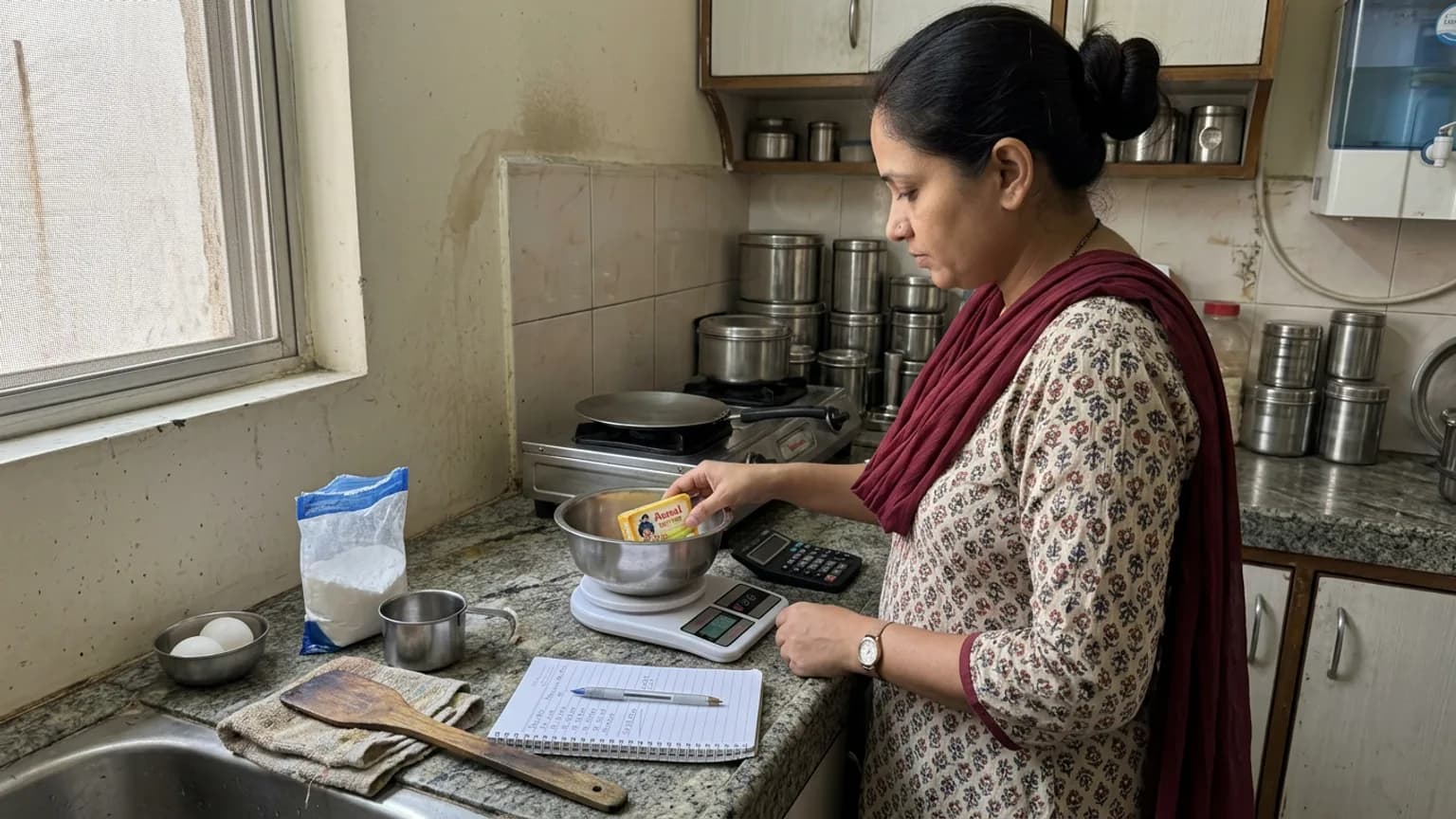
Cost out the recipe by weight: if butter is ₹480 a kilo, 200 g is ₹96. Add 5 to 10 percent for spillage, trimming and the odd failed layer.
Packaging
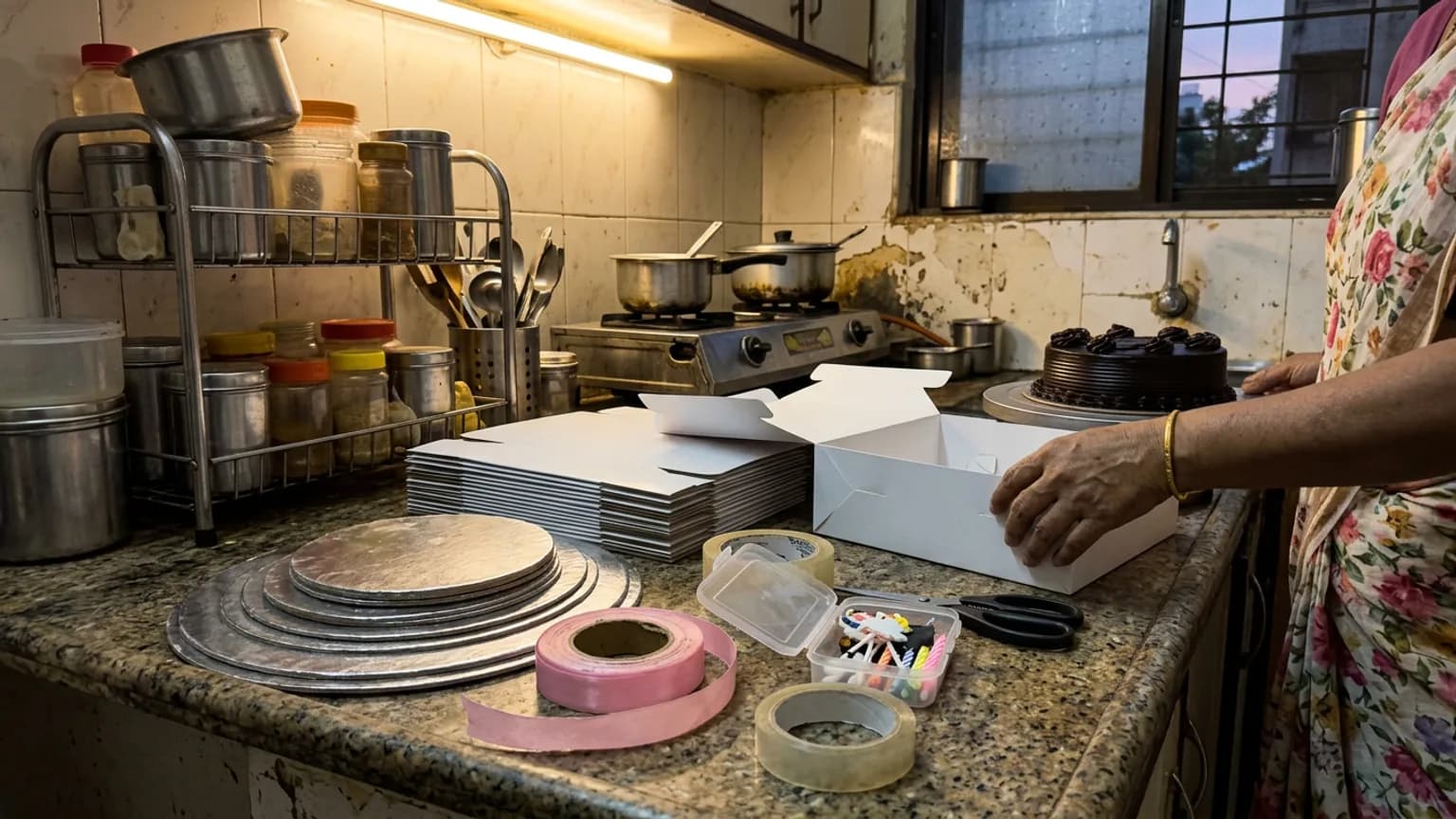
The box, the cake board, ribbon, tape, a card. Count them per cake, not per bulk pack.
Your time
Count everything: shopping, baking, cooling, decorating, packing, and the time you spend on the order itself. Multiply by an hourly rate you would accept from someone else.
Overheads
Gas, electricity, water, your phone bill, small tools that wear out. Divide the month's total by the cakes you bake to get a per-cake share.
Delivery, if you include it
Charge the real cost of getting the cake to the door as its own line, rather than hiding it in the cake price.
Your margin
Add a percentage on top of the total for profit and for the months you earn less. Many Indian bakery guides suggest roughly 25 to 40 percent.
A worked example: a 1 kg chocolate truffle cake
Here is the sum for one cake, using example figures. Your own ingredient prices and hourly rate will differ.
| Cost | Example | How it is worked out |
|---|---|---|
| Ingredients, with wastage | ₹420 | Recipe costed by weight, plus about 8% wastage |
| Packaging | ₹60 | Box, board, ribbon, tape |
| Your time | ₹525 | 3.5 hours at ₹150 an hour |
| Overheads | ₹60 | Gas, electricity, small tools |
| Total cost | ₹1,065 | Add the four lines above |
| Price with a 25% margin | ₹1,350 | ₹1,065 plus about ₹266, rounded to a clean number |
Two quick checks on that answer. First, compare it with the rule of thumb you will see in many guides, which is to price at roughly three to four times your ingredient cost. Here that is about ₹1,260 to ₹1,680, so ₹1,350 sits inside the range. Second, if your bottom-up number comes out far below the rule of thumb, you have probably left out a cost, usually your time.
Price each size, not just the one you like
A half-kilo cake does not cost half of a one-kilo cake. The box, the setup, the decorating and your time do not shrink in proportion, so scaling the price down by half loses money on small orders and the small orders are most of them.
| Size | Total cost | Price with 25% margin |
|---|---|---|
| ½ kg | ₹670 | ₹850 |
| 1 kg | ₹1,065 | ₹1,350 |
| 2 kg | ₹1,760 | ₹2,200 |
In this example the half-kilo cake costs about 63 percent of the one-kilo price, not 50. Work each size out from its own costs, then write the three prices down and keep them fixed.
Charge for the extras separately
Fondant work, figurines, edible prints, a photo on the cake and rush orders all take extra hours or materials. Give each its own add-on price, so the base cake stays simple and the custom work pays for itself. For designs you cannot price up front, give a quote after the customer describes what they want.
Check your price against the market, not the other way round
Once you have your number, look at what similar home bakers in your city charge for the same size, flavour and finish. You are looking for a sanity check, not a target. If you are far above, your photos, your reviews and your reliability have to justify it. If you are far below, you are probably subsidising your customers.
Do not chase the lowest price on the street. Reliable bakers in festival weeks are scarce, and buyers looking for a dependable cake for an occasion tend to pay for that dependability. For a festival-week example, see our plan for a Diwali hamper business from home.
Know your real profit every month
A price is only right if the books agree. Each month, add up what you took in and what you spent on ingredients, packaging, gas and delivery. What is left is your profit, and dividing it by your hours tells you what you earned per hour.
On KioSnap, you can record your spending under track your expenses and read revenue, expenses and profit together on the analytics screen, instead of rebuilding them from notebook pages and payment screenshots.
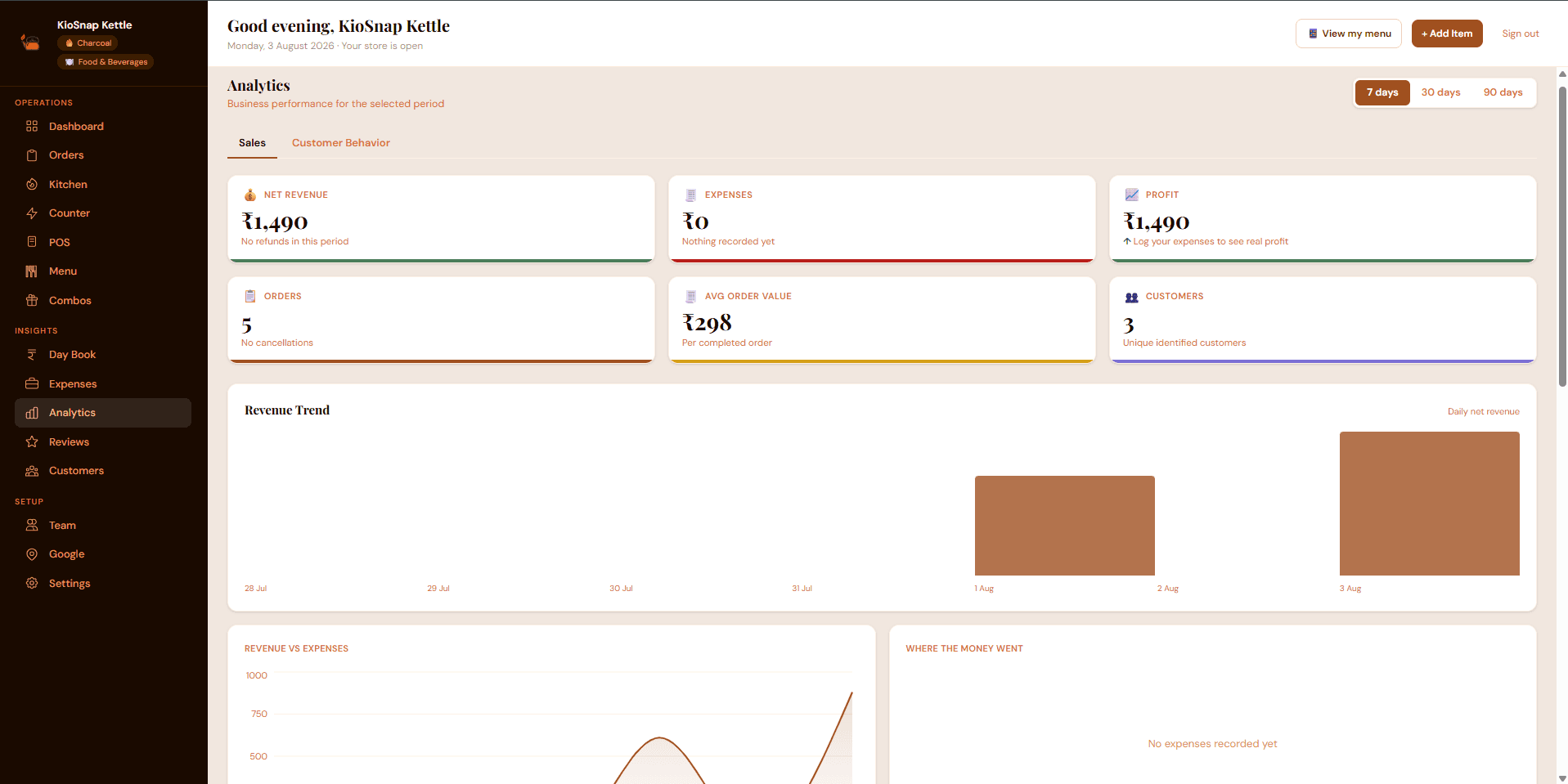
If profit per hour is lower than you expected, raise prices on the cakes that take the most time, or trim the costs that surprised you, before the next festival week.
Put the prices where customers can see them
A price list you keep in your head gets negotiated in DMs. Publish the sizes and their prices once, and customers choose instead of asking. On KioSnap, you can list one cake with each size as its own priced option; see sell in sizes with variants. To take orders with dates and delivery, read how to take cake orders online as a home baker.
Taking orders on KioSnap starts on the Charcoal plan at ₹299 a month, after a 14-day free trial and a one-time ₹199 setup. The free Wood plan shows a three-item catalog on your own link. There is no commission on your sales; you collect payment from customers yourself. Details are on the pricing page, and the page for home bakers shows how it fits a home kitchen.
- to start on the free plan
- ₹0
- a month to take orders
- ₹299
- free trial on paid plans
- 14 days
- commission on your sales
- 0%
The short version
Add up ingredients, packaging, your time, overheads and delivery, then add a margin, for every size you sell. Check the answer against the market, record your spending, and revisit the numbers each season. A cake priced by sum pays you for the work it takes.
Pricing guides from Indian baking educators and bakery blogs, such as this one on pricing baked goods for home bakers and this one on bakery pricing strategy in India, put healthy margins and ingredient multipliers in similar ranges. Treat those figures as estimates, and let your own costs decide.
Common questions
How much should I charge for a homemade cake?
Add up your ingredients with wastage, packaging, your time, overheads and delivery, then add a margin of roughly 25 to 40 percent. The result is your price for that size; a price copied from a shop is not.
What is a good profit margin for a home baker?
Indian bakery guides commonly suggest about 25 to 40 percent on top of total cost. Treat it as an estimate and adjust for how busy you are and what your customers will pay.
Should I charge per kg or per cake?
Per size is safer. A half-kilo cake costs more than half a one-kilo cake, because the box, setup and decoration time do not halve. Work out each size and fix its price.
How do I price a custom or theme cake?
Price the base cake by size, then add separate charges for fondant work, figurines, prints and rush orders. For designs you cannot price up front, quote after the customer explains what they want.
How often should I change my cake prices?
Review them every season and whenever butter, cocoa or cream moves noticeably. Recost one batch and compare it with your current price before festival weeks.
Put this into practice today
Create your free storefront in minutes. No app for your customers, zero commission on your sales.